Horizontal team coordination in padel – how to close the gaps
Horizontal coordination is how well you and your partner move together across the width of the court. Stay within 4 metres of each other horizontally to close gaps and stop giving opponents easy openings.
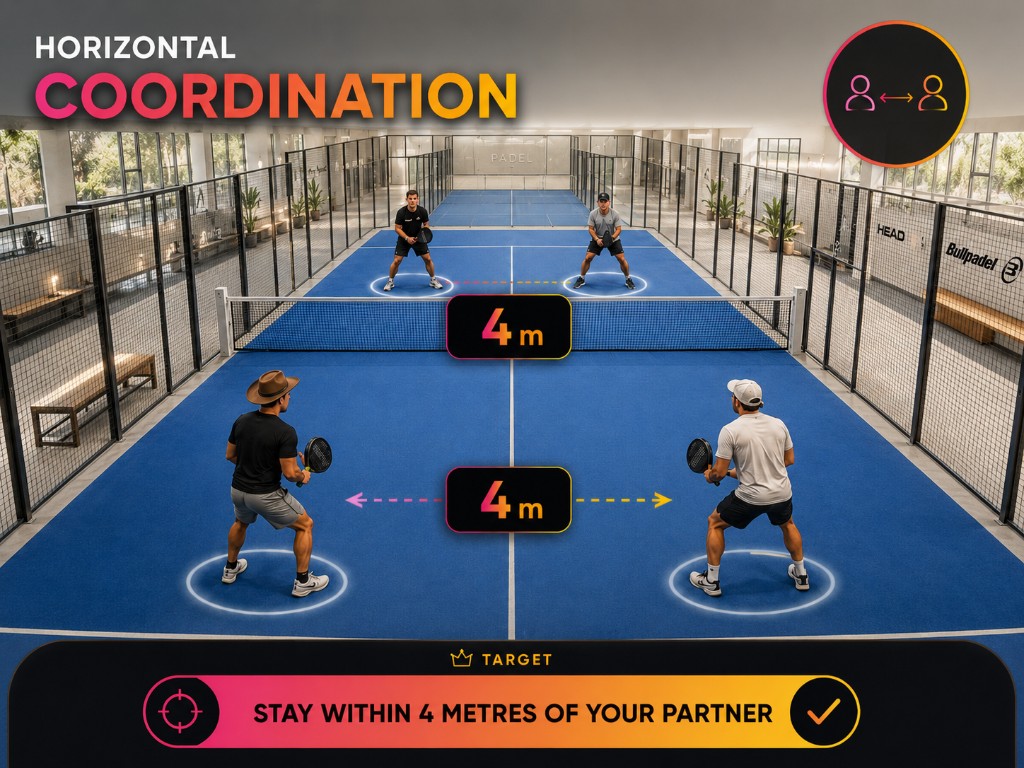
Horizontal Team Coordination in Padel: Close the Gaps
Key takeaways:
- Horizontal coordination is how well you and your partner move together across the court width — left to right.
- Stay within about 4 metres of each other horizontally so you do not leave gaps for opponents to attack.
- Own your side of the court, but slide together when one of you has to cover extra ground.
In padel, most players understand that you should move forward and back as a pair. That is vertical coordination. Just as important — and often overlooked — is horizontal coordination: how well you and your partner cover the court from sideline to sideline.
When horizontal coordination breaks down, the result is the same every time: a gap opens up, and your opponents find it.
What Horizontal Coordination Actually Means
Horizontal coordination describes how well your team moves together across the width of the court.
Think of it this way: as a pair, you are responsible for covering your half of the court from left to right. When one player drifts too far to their side while the other stays central — or when you both chase the same ball and leave the opposite side empty — you create space that good opponents will punish immediately.
In your Bandeja AI match analysis, horizontal team coordination is one of the metrics that shows how consistently you and your partner stay aligned across the court width throughout a match. Low scores here usually mean visible gaps, especially down the middle.
The 4-Metre Rule: Stay Close Enough to Cover the Court
A simple target that works at every level: stay within about 4 metres of each other on the horizontal axis.
That distance keeps you close enough to:
- Cover the middle together
- Slide across to help when your partner is pulled wide
- Recover quickly after a shot without leaving half the court open
When you stretch beyond 4 metres, gaps appear fast. The most common pattern is one player pushed to the sideline while the other stays too central — suddenly there is a lane down the middle, or a deep space behind the player who has been dragged wide.
The fix is not complicated: move as a unit left and right, not just forward and back. If your partner shifts left to cover a shot, you shift with them. If they recover to their side, you recover to yours — but always as a pair, not two independent players.
Own Your Side — Then Move as a Pair
Before any calling or communication, you need a clear picture of side ownership.
If you play the right side, your half of the court is yours to cover. Your partner covers their half. The two of you move forward and back together — and you should slide horizontally together too.
This is different from tennis doubles, where partners are often staggered and switch sides when a ball goes over someone's head. In padel, you are generally side by side. If a lob goes up over your side, it is usually your ball — you take it and recover to your own side.
There are exceptions, but side ownership is the starting point. Without it, partners collide, hesitate, or both leave the same space empty.
When to Cross Over (and When Not To)
You cover your own side, but not blindly. The guiding idea is the advantageous shot: if your partner can come across and play a clearly better shot than you can, they should call for it and take it.
Two common examples:
- Your partner is much closer to the ball. You have run tight to the net and get lobbed. Your partner, further back, is better placed to reach it. They call "mine," play the ball, and you slide across to cover their side or simply get out of the way and recover.
- A forehand beats a backhand off the glass. You are both at the net and get lobbed over your backhand side. It may be awkward for you to be aggressive off the back glass with a backhand — your partner's forehand from the middle is often the better option.
When your partner crosses over, be mindful of the space it opens. The further they travel, the more of their own side they leave exposed. The exception applies to that nearby middle area where the forehand is genuinely better — not to every ball on the court.
Quick Checklist
- Stay within about 4 metres of your partner horizontally — move left and right as a unit
- Own your side of the court; slide together when one of you has to cover extra ground
- Check your horizontal coordination score in Bandeja AI to see how consistently you stay aligned
Strong horizontal coordination is trained behaviour — and it starts with staying close enough to close the gaps. Ready to see how your pair measures up? Upload your next match.