Team coordination in padel – how to move together
Coordinated movement is what separates solid padel teams from inconsistent ones. Learn how to move as a unit, attack together, defend together, and stop giving away easy points.
Move as One: The Key to Better Team Positioning in Padel
If there's one simple principle that can instantly improve your padel game, it's this: you and your partner should move as a unit.
Whether you're attacking or defending, coordinated movement is what separates solid teams from inconsistent ones. Many players focus on individual shots, but in padel, positioning as a pair is what truly controls the point.
Let's break down how it works.
Why Moving Together Matters
In padel, court positioning is everything. When you and your partner stay aligned—both forward or both back—you reduce gaps and make it harder for opponents to exploit space.
When you don't? You leave openings—especially down the middle—that are easy to attack.
At a high level, the rule is simple:
- Move forward together to attack
- Move back together to defend
This coordination is a core part of effective team play and directly impacts your overall positioning and performance metrics.
Moving Forward: Attack as a Pair
The ideal time to move forward is when you've hit a shot that gives you control—most commonly a lob.
Example:
You hit a high, deep lob → your opponents are pushed back → You and your partner move forward together to the net.
Why this works:
- You cut off angles
- You take control of the point
- You apply pressure
But here's where many players go wrong.
The Common Mistake
Some players rush forward without giving their partner a signal—for example, after a regular shot.
This creates confusion:
- One player moves forward
- The other stays back
- The team becomes split
Now you've created:
- Gaps in the middle
- Poor court coverage
- Easy opportunities for your opponents
What to Do Instead
Make your intention clear through your shot selection:
- Use a lob → obvious signal to move forward
- Use a chiquita (soft shot to the feet) → controlled approach
Your movement should always be predictable to your partner.
Moving Back: Defend as a Pair
The same principle applies in reverse.
If your partner is forced to move back—especially after a lob—you must follow.
Example:
- Your partner runs back to retrieve a lob
- You stay at the net
What happens?
- A huge gap opens behind you
- Opponents can easily play into that space
The Correct Reaction
- If your partner goes back → you go back too
- Reset together and rebuild the point
This keeps your structure intact and avoids giving away easy points.
The Bandeja Situation: A Subtle but Important Detail
One situation that often causes confusion is when defending a lob with a bandeja.
What your partner expects:
If you hit a bandeja, you're usually trying to:
- Maintain control
- Recover the net position
So your partner will assume you're coming forward again.
The problem:
If you hit a bandeja but stay at the back, your partner:
- Has already shifted forward mentally and physically
- Loses awareness of your position
- Leaves space open
The rule:
- If you play a bandeja → recover forward
- If you can't recover → play off the back glass and reset together
Consistency matters more than improvisation here.
Why This Matters for Your Game
Strong teams don't just hit better shots—they move better together.
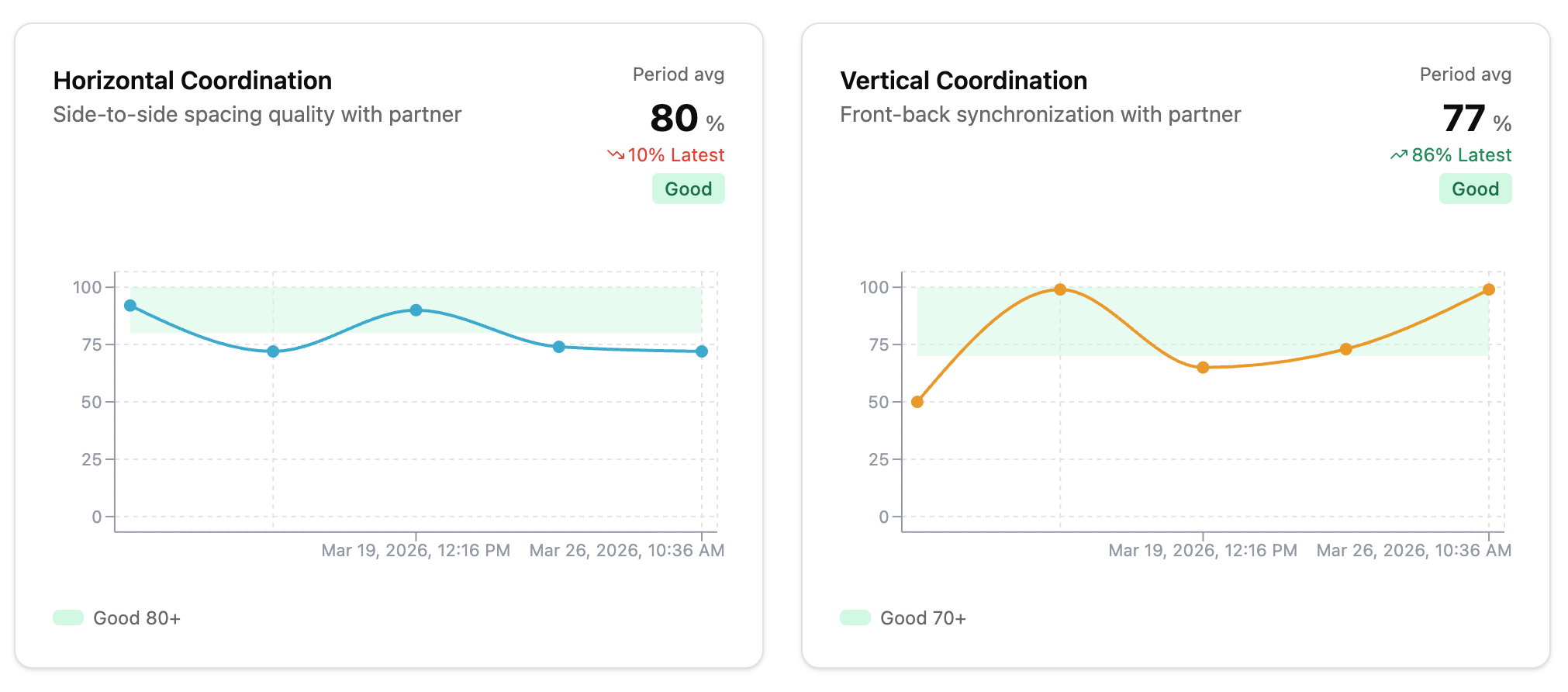
In fact, coordinated movement directly impacts advanced performance metrics like:
- Vertical team coordination (moving up and back in sync)
- Horizontal team coordination (moving left-right as a unit)
- Net possession percentage
At higher levels, teams spend:
- 40–50% of time at the net
- Move forward and back in sync most of the time
This isn't accidental — it's trained behavior.
Key Takeaways
- Always think in pairs, not individually
- Move forward together after controlled attacking shots
- Move back together when defending
- Make your intentions predictable through your shots
- Prioritize positioning over rushing the net